
Macomb Township Directory Collections
Macomb Township is a charter township, while the main historical shelves sit nearby in Mount Clemens and across county collections. The published span for the Mount Clemens City Directory Master Index is 1896 to 1966. That is an index span, not proof that every year survives or that every volume covers the township. The volumes are still valuable when a household had a Mount Clemens connection, a listed business, or an address that needs to be compared with a county record.
| Collection | Years | Where Held | Access |
|---|---|---|---|
| Mount Clemens directory master index | Published index span, 1896 to 1966 | Mount Clemens Public Library | Best used on a library computer; ask staff for a volume or page |
| Miller & Dalby directory | 1899 to 1900 | Library and University of Michigan directory research | Historical name and address evidence |
| Miller & Lefevre directory | 1901 to 1902 | Library and university research | Historical name and address evidence |
| John L. Miller, Gatz & Behnke volumes | 1905 to 1906, 1911, 1913 to 1916, 1921, 1923, and 1925 listed | Library, university research, and digitized 1905 to 1906 item | Compare the scan with the index and confirm the volume |
| Farm Journal Rural Directory of Macomb County | 1916 to 1921 run identified | Library and university research | Rural county context, distinct from a city volume |
| Yearbook, obituary, funeral, and newspaper indexes | Dates vary by index | Mount Clemens Public Library and Heritage Alliance | Index citation, staff request, microfilm, or archival research |
A missing year is not a missing household. Publication gaps, the city-versus-township boundary, and a different spelling can all interrupt a run. County government directories are separate publications that identify offices and departments, not household occupants.
Macomb Township Historical Directory Shelves
The Mount Clemens Public Library Local History & Genealogy Room is the central local stop for this work. It reports more than 300,000 print volumes, more than 5,000 microfilm reels, subscription databases, and locally produced Macomb and Mount Clemens indexes. The current listed schedule is Monday and Tuesday from 10:00 to 6:00, Wednesday noon to 6:00, Thursday 10:00 to 6:00, Friday 10:00 to 5:00, and Saturday by appointment. Macomb County Genealogy Group volunteers cover selected hours.
The room is at 150 Cass Avenue in Mount Clemens, and its Local History and Genealogy contact is 586-469-6200, extension 6. A library computer is the sensible first stop for a master-index hit. Staff can then point to a volume, a microfilm reel, a newspaper index, or a request service instead of treating a web search as the whole collection.
The Macomb County Heritage Alliance resources show why a directory search often needs more than one shelf.
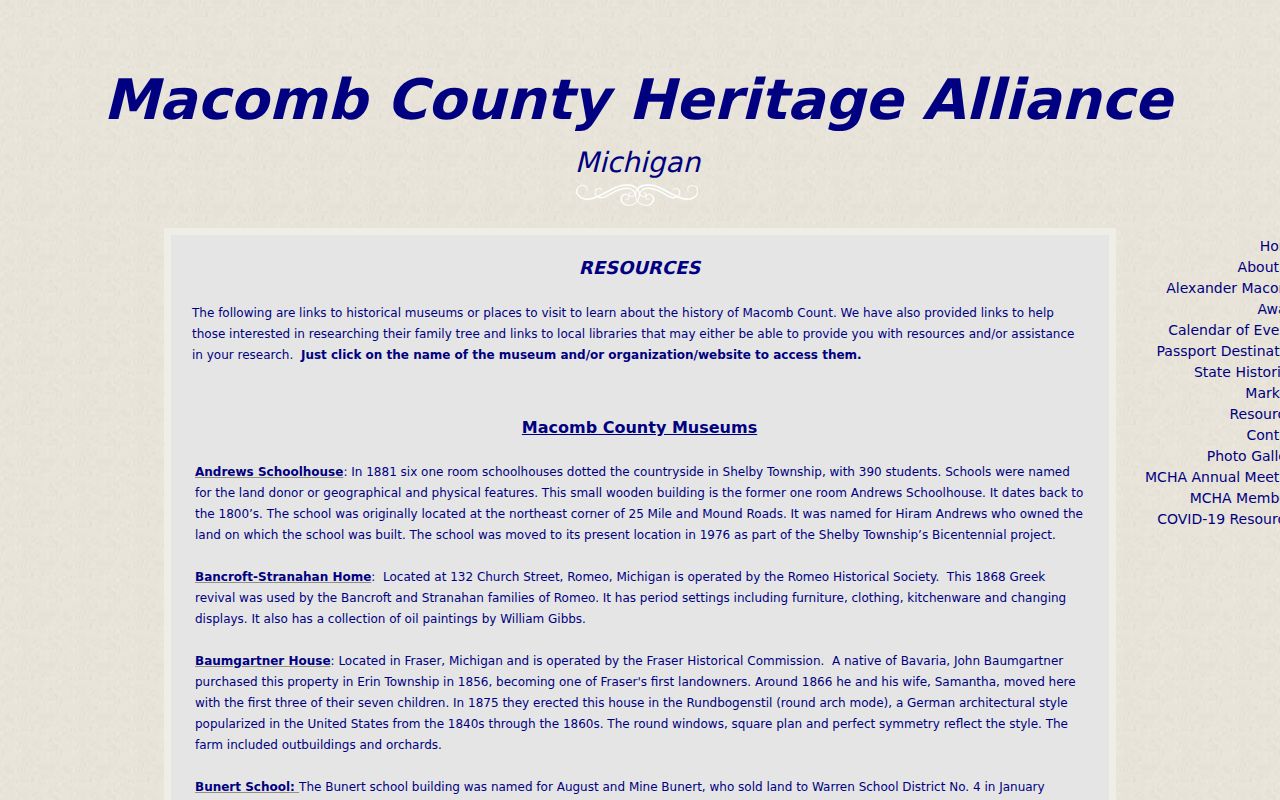
Heritage Alliance holdings include family files, directory material, plat maps, tract books, cemetery transcriptions, newspapers, church and funeral indexes, naturalization material, and yearbooks. These can help test whether a name in a directory belonged to the same household or business.
Macomb Township Directory Publisher Years
The cited University of Michigan Clements directory research identifies a sequence of publishers rather than one uninterrupted local series. That detail matters because a title and compiler help determine what kind of entry was collected. The Farm Journal rural run, for example, should not be read as if it were the same kind of publication as a Mount Clemens city volume. Record the title page and publication year before copying a name into a family timeline.
- 1896: the library's published master-index span begins, although gaps have not been confirmed.
- 1899 to 1900: Miller & Dalby published a Mount Clemens directory.
- 1901 to 1902: Miller & Lefevre published the listed directory run.
- 1905 to 1906: John L. Miller and Gatz & Behnke compiled the digitized volume.
- 1916 to 1921: the identified Farm Journal rural-directory run supplies county context.
The master index ends its published span at 1966, but the exact last printed local year was not located in the official sources. Treat that endpoint as an index description, not as a promise of complete annual coverage.
Open a Macomb Township City Directory
The 1905-06 Mount Clemens directory at MichMemories is a digitized starting point. Its metadata identifies the issue year as 1905, calls the subject directories, lists the Suburban Library Cooperative as the institution, and notes Library of Michigan-administered LSTA support. The item links through a montage viewer. It is a historical city directory, so an address outside Mount Clemens still needs a township or county jurisdiction check.
The digitized item record preserves the publication context that a plain name search loses.
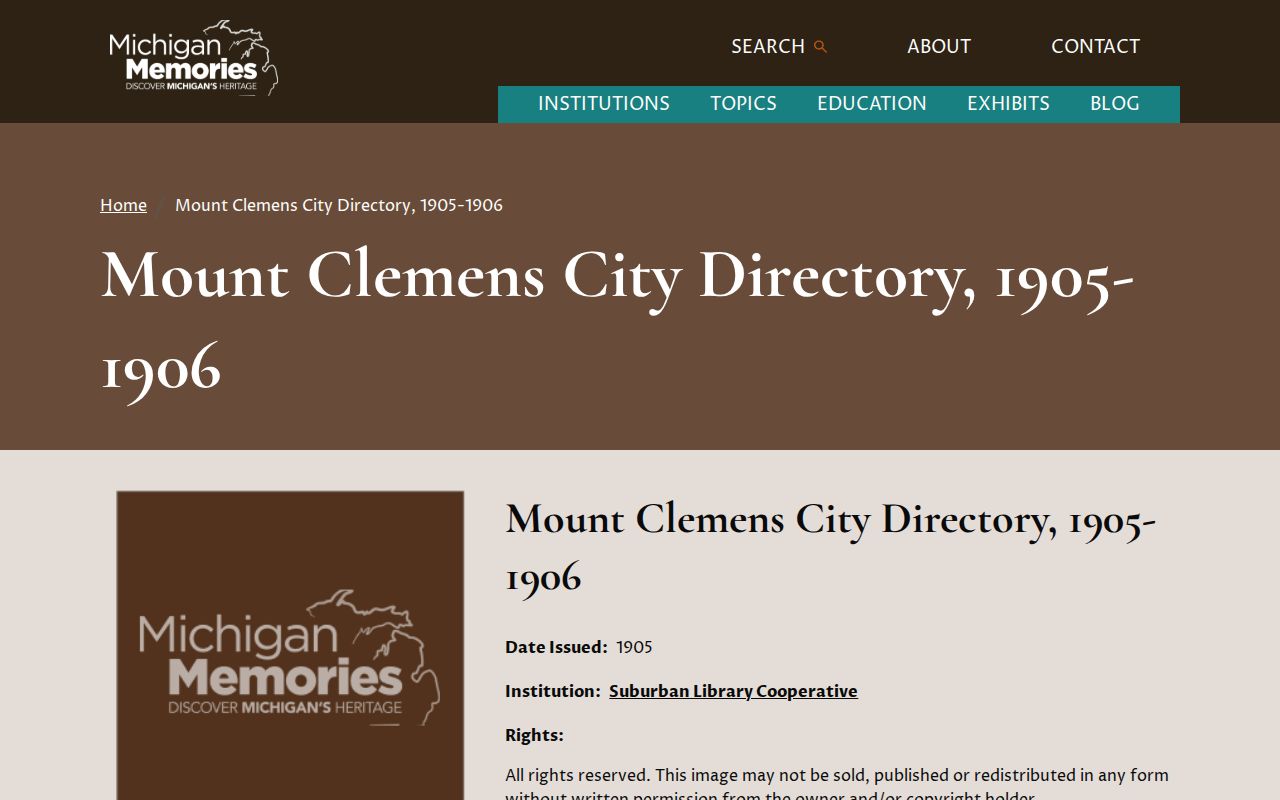
Use the item title, year, and image location when taking notes. That citation makes it easier to revisit an entry after a surname spelling or street name has been corrected.
Reading a Macomb Township Directory Entry
A historical city directory entry is a snapshot, not a current resident record. The university's directory-derived examples show how much can fit in a short line or business listing. A.F. Mann & Son appears as photographers at 77/79 Gratiot Avenue North with telephone 300. Myrtle B. Mann is identified as an office lady connected with the business. Frederick C. Brown appears at changing addresses across the early twentieth century. Copy exactly what the entry says, then look for an independent record before joining it to a family.
| Title and year | Identifies the publication snapshot and the edition to cite. |
|---|---|
| Publisher or compiler | Shows which series produced the entry and helps distinguish rural from city material. |
| Individual or business name | Preserves the spelling, initials, and whether the listing is a person or enterprise. |
| Occupation or business connection | May identify work such as photographer or a connection to a listed business. |
| Street address and telephone | Places the entry at an address in that publication year and may include a phone number. |
| Relationship or household notation | May appear in a volume, but a stable scanned legend for local household-status or abbreviation marks was not located. |
- Criss-cross directory
- An address-ordered section of a directory series, when a volume includes one. It can help move from a known street to a listed household or business.
- Householder index
- An index organized around the named household head rather than every person connected with an address. Check the volume's own scope before assuming full coverage.
- Abbreviation key
- The legend that explains shortened words or symbols in a particular volume. Read it only if the scan or physical book includes one, because a stable local legend was not captured.
Do not supply relationship, household-status, or abbreviation meanings from memory. The local evidence supports the listed fields, while volume-specific symbols must be read from the actual page.
Macomb Township Directory Companions
When a name disappears from a local directory, the library's companion indexes can help separate a move from a death, school connection, probate matter, or simple gap in publication. The library index list names a Funeral Home Master Index with 227 volumes covering 17 homes, obituary material from 1941 forward, a Macomb Daily news index from August 1994 forward, a high-school yearbook index from 1917 forward, a local 1930 census index, probate material, cemetery records, and military indexes. None of those is a substitute for the directory, but each can corroborate a dated listing.
- Use an obituary or funeral-home citation to test a final known directory appearance.
- Use the yearbook index for a former classmate, keeping any address historical.
- Use probate index or microfilm when an estate may explain a transfer or change.
- Use cemetery and church indexes for older family evidence.
- Use newspaper notices for moves, business openings, deaths, and community events.
The library's genealogy request service lists indexed copies at $4 each or three for $10. Requests without an index citation cost $10 each, so a precise directory year and name can save time.
Trace Macomb Township Directory Households
Start with a directory year, not an assumed lifetime address. Record every spelling, initial, occupation, phone number, and street form. Then inspect adjacent available years. Pair a directory entry with the closest released federal census, which is currently available through 1950 under the 72-year release rule. The directory can suggest an occupant or business presence, while a census supplies a household snapshot and a deed or assessor record addresses ownership.
- Find the first known name or address in a dated volume and save the full citation.
- Check adjacent available directory years for moves, spelling changes, and business changes.
- Compare the directory year with the nearest released federal census and the library's local 1930 census index.
- Use a deed, assessor entry, or plat only to test the ownership side of the address.
- Close an uncertain trail with a newspaper, obituary, cemetery, or probate record.
For a present-day address chain, the Macomb Township by-street directory uses the modern property and parcel route. A person can be listed in an old directory without having owned the building, and a present owner can have a mailing address elsewhere.
Macomb Township Directory House Histories
Local house-history narratives show how directory evidence fits into a longer record trail. The library's Railroad Inn narrative places Kandt Brothers and John Kandt at 304 Cass, notes a 1903 brick building, and follows later grocery businesses and later occupants through directory material. It combines that evidence with Sanborn maps for 1888, 1892, 1897, 1903, 1909, 1921, and 1930, plus a title abstract covering 1808 to 1965.
The Wilson's Cafe narrative uses the same local method: land transfers, maps, newspapers, and directory entries. That approach is more reliable than forcing one name into one address. It also shows where a directory is strongest, as dated evidence of occupancy or a business connection.
Macomb Township Historical Directory Limits
Directory evidence has clear boundaries. The Mount Clemens material does not automatically cover all of Macomb Township, and a mailing city is not a legal jurisdiction line. A historical entry may name a business, an occupant, a household connection, or an address in a publication year. It does not establish current residence, title ownership, or a complete household. Road aliases can also change the way an old address appears, so compare the publication's street wording with a parcel, legal description, or map before ruling out a match.
Use library computers, staff help, microfilm, email or mail research requests, and Heritage Alliance collections when an online index fails. The historical shelf is broad, but it is fragmented by custodian and era. Note: A careful citation preserves the year, source, spelling, and address without turning a historical directory entry into a claim about a living person.