
Macomb Township Previous Residents by Era
One address needs different sources for different periods. The township's parcel record gives the current ownership side, while the county recorded-document index connects names to deeds and legal descriptions. Older city and rural directories can show a household or business at an address in a publication year. Census, maps, permits, newspaper material, and probate can fill the spaces between those records. Keep the source date beside every name, because a change in owner does not automatically identify everyone who lived there.
| Source | Years It Covers | Where Held | What It Shows |
|---|---|---|---|
| Macomb Township Assessing and BS&A | Current online system; start year not located | Township and BS&A | Current owner, situs, mailing address, values, sales, PRE, and improvements |
| Tyler recorded-document index | Exact online start not located; older books and microfilm require inquiry | Macomb County Register of Deeds | Grantor, grantee, instrument, date, document reference, and legal description |
| Mount Clemens city directories | Published index span 1896 to 1966; listed publishers 1899 to 1925 | Library, university research, and MichMemories | Occupant or business, address, occupation, telephone, and publication year |
| Farm Journal rural directory | 1916 to 1921 identified run | Library and university research | Rural household and property context |
| Sanborn maps | 1888, 1892, 1897, 1903, 1909, 1921, and 1930 | Library narratives and Library of Congress collections | Building footprint, use, materials, and nearby structures |
| Federal census | Released on a 72-year rule; 1950 is currently available | NARA, library, and genealogy databases | Household composition, age, occupation, birthplace, and address geography |
| Newspaper, obituary, and probate sources | Coverage varies by collection | Library, Heritage Alliance, and Probate Court | Death, estate, heirs, moves, business notices, and family relationships |
For a recent transfer, begin with the assessor and recorder. For an older household, begin with a dated directory or census result and work toward the parcel and deed record. Maps and permits date the building or a physical change, not every person connected with the address.
Start a Macomb Township Past Residents Trail
The Macomb Township Assessing office maintains roughly 34,500 real parcels and 1,000 personal-property accounts. Its public records include owner and sales information, legal descriptions, values, buildings, improvements, and property-transfer or principal-residence information. The BS&A Online Public Records portal accepts an address, name, parcel number, building-department record number, utility account number, and selected receivables information. Record the parcel ID, situs address, owner spelling, mailing address, legal description, subdivision or lot, and latest sale before opening the deed index.
Situs means the physical parcel location. A mailing address is where tax notices go and can be elsewhere. A principal-residence flag is assessment evidence, not proof of every occupant. The assessor allows public inspection from 8:00 to 4:30, takes inquiries at assessor@macomb-mi.gov or 586-992-0710 extension 2, estimates three to seven business days for production, and may require a Michigan FOIA request for some records. The online portal is available around the clock but warns that data may be incomplete or inaccurate.
Macomb Township Deed Chain Backward
The deed chain is the ownership half of past-resident research. Use the parcel card to anchor the legal description, then take the current owner's exact name to the county recorder. In the advanced index, search that owner as the grantee or buyer, inspect the deed type, date, and document or liber-page reference, and identify the prior grantor or seller. Search that seller as a grantee in an earlier record. Repeat the sequence while checking that the legal description and parcel history still match.
- Copy the current owner, parcel ID, situs, legal description, subdivision or lot, and latest sale date from BS&A.
- Search the owner as grantee in the recorder index and identify the deed that brought the property to that owner.
- Record the instrument type, recording date, document or liber-page reference, and the prior grantor.
- Search that prior grantor as a grantee to find the earlier acquisition, then repeat the comparison.
- Check the legal description at every turn and branch forward through grantor records only as a later-transaction clue.
- Grantor
- The party conveying a recorded interest. In a sale, this is usually the seller named on the instrument.
- Grantee
- The party receiving the recorded interest. In a sale, this is usually the buyer named on the instrument.
- Chain of title
- The succession of recorded transfers tied to the same property. It tracks recorded interests, not a complete list of every occupant.
- Legal description
- The parcel's formal land description, such as a lot, subdivision, or metes-and-bounds reference. It can bridge records when street text changes.
Address searching can help, but it may fail after a lot split, condominium conversion, readdressing, or a spelling change. The legal description and parcel history keep the chain tied to the same land.
Macomb Township Recorder Online Boundary
The Macomb County Register of Deeds search-options page offers a free basic grantor, grantee, or name search. Its advanced search adds address, legal description, parcel ID, names, and copy or certification requests. The online start year is not located in official sources. The county also warns that official records may not yet be fully indexed or verified, so a blank result should not be treated as proof that no earlier deed exists.
The Tyler-hosted official-records route is the online doorway to the recorded-document index.
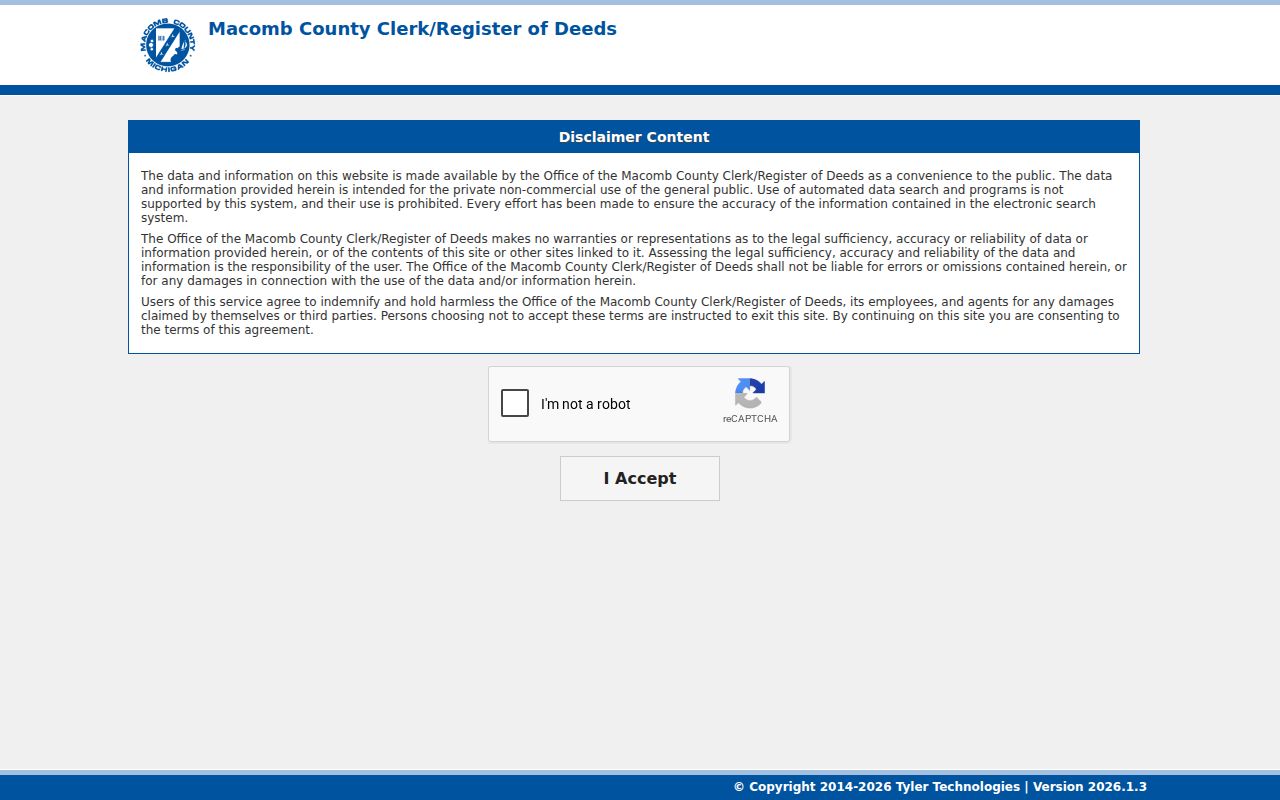
When the online result stops, ask the recorder about older deed books and microfilm, then use the free public index terminals at 120 N. Main Street in Mount Clemens. Staff searches cost $5 per search plus $1 per page; mail requests use the county real-estate form and need enough party, address, legal-description, or parcel detail to locate the record. The office recommends appointments and does not make copies after 4:30 p.m.
Advanced access is listed at $25 for 24 hours plus $1 per document, $75 for one week plus $0.75 per document, or $250 for one month plus $0.50 per document. Requests over 15 pages are available the next business day after noon. These routes matter for a past-resident trail because the online cutoff and older record coverage have not been published.
Macomb Township Historical Road Names
Street text can hide the same historical place. Township history identifies 20 Mile as M-59, Hall, or Rosso; 21 Mile as Shoemaker; 22 Mile as Waldenburg; 23 Mile as Romeo Plank or Whiskey on the east and Coldwater on the west; 24 Mile as French; 25 Mile as Arnold; and 26 Mile as Marine City Highway. Search the road alias used in the old source as well as the modern street form. A directory, deed, map, or newspaper can retain older wording.
No official township street-renumbering year, major renaming project, or annexation map that changed modern addresses was located. Do not invent one. Use the legal description, parcel number, subdivision or lot, current ZIP, and map as the bridge. The county GIS office is the informed contact for parcel geography and addressing questions, but the exact E911 address-assignment office and policy were not located.
Macomb Township House History Evidence
The Railroad Inn house-history narrative shows the local method in action. It places Kandt Brothers and John Kandt at 304 Cass in directories, notes a 1903 brick building, identifies later grocery businesses and later occupants, and uses Sanborn maps for seven years from 1888 through 1930. The narrative also relies on an abstract of title running from 1808 to 1965. It is a model for combining dated occupant material with land transfers and building evidence.
The Wilson's Cafe narrative follows a similar pattern of maps, land transfers, newspapers, and directory entries. Township permit applications can also bracket a foundation, addition, roof, pool, demolition, occupancy certificate, or plot plan. A permit may identify an owner or applicant, but the public historic permit-search interface and its start year were not located. Treat permits as chronology evidence rather than a complete household roll.
Macomb Township Previous Residents in Census Years
Ownership is only one part of an address history. Dated directories can identify an occupant or business at the address, while a released federal census gives a household snapshot. The Macomb Township city-directory collections provide the publisher runs, shelf locations, and entry-reading details. Pair each directory date with the closest census year, then place it beside the deed chain instead of blending the sources into one claim.
- Start with the address in a dated directory and copy its spelling, initials, occupation, telephone, and street form.
- Check adjacent available directory years for a move, a different household name, or a business change.
- Compare the closest released federal census, including the library's local 1930 census index, for a household-level snapshot.
- Check the deed chain for ownership and the legal description for property continuity.
- Use a newspaper, funeral-home index, obituary, cemetery record, or probate file to test an endpoint.
A name disappearing from a directory can mean a move, a death, a gap, a city-township boundary change, or an unlisted person. The sequence deed to directory to newspaper, funeral or probate material, then cemetery or vital confirmation is stronger than any single result.
Macomb Township Past Residents at Trail End
Obituaries, funeral-home indexes, probate filings, and cemetery records can close a chain by documenting a death, heirs, family relationships, or an estate address. The Mount Clemens library lists a Funeral Home Master Index of 227 volumes across 17 homes, obituary coverage from 1941 forward, probate indexes and microfilm, and a local news index. The Macomb County Heritage Alliance adds older newspapers, cemetery transcriptions, church and funeral indexes, partial probate, and family files.
Recent material has different limits. The county genealogy office allows public inspection Tuesday through Thursday from 9:00 to 11:30, but it restricts later death and marriage indexes. Probate's public party-name lookup returns a case number and judge; the full filing is held at the court. Use the record custodian for a formal copy, and keep a note of the exact source, date, and role a person had in the document.
Macomb Township Previous Residents Use Limits
A former address may reveal a long family or building story, but those records have limits. An assessor mailing address does not prove a person lived at the parcel. A directory is dated historical evidence. A recorded deed proves a transaction, not a current location. Sensitive records can be restricted, and Michigan's Address Confidentiality Program uses substitute-address protections for eligible participants. Use personal, lawful research methods and verify material facts with the office that holds the underlying record.
Lawful house-history use. Use Macomb Township past-resident research for family history, estate questions, preservation, or personal curiosity. Do not use historical or current records to stalk, harass, or harm a person.
Note: Preserve the source date and the record's actual wording, especially when an old address, parcel, or surname has more than one plausible match.